

2009 Stocking Schedule
Check the lists for the latest locations, numbers and species of trout that will be stocked in local waters.
Virginia»Maryland »
Pennsylvania»
"Our worst nightmare has come true"
 Fire boat response crews
battle the blazing off shore oil rig
Deepwater Horizon April 21,
2010.____________________________U.S.
Coast Guard photo
Fire boat response crews
battle the blazing off shore oil rig
Deepwater Horizon April 21,
2010.____________________________U.S.
Coast Guard photo
That opinion was voiced at a May 23 news conference by Plaquemines Parish President Billy Nungesser, who was disappointed with officials from British Petroleum and the federal government for handing out excuses instead of immediate help to stem the flood of oil heading for the sensitive marshlands of Louisiana. And after watching a month of this slow motion train wreck going on in the Gulf of Mexico I would agree with Nungesser that this is an ecological disaster that will be with us for years if not decades.
Watching the oil spill unfold is like watching a slow motion train wreck. We won't really know how bad this will be, or how far the spill will reach, until the leak is stopped and the final scope of the leak can be accurately determined. In the meantime, fellow anglers--those who fish, crab and shrimp the Gulf of Mexico are hurting. Those who are responsible have promised compensation but what price do you put on a way of life that stretches five or more generations?
And what's the fishing situation like now? Well it depends. I tried contacting some people in Louisiana who are in the industry but most declined to comment or we had off-the-record conversations. One of the only written response came from Dayne Larsen, manager at the Uptown Angler fly shop in New Orleans.
"For us the fishing is still good and probably will remain that way for some time," said Larsen. "Most of the marsh has no oil in it at all. There are booms in many places in anticipation of oil (and) about half of our saltwater marsh is closed to fishing. The closing are due to boom blocking waterways, oil and the worry that seafood is contaminated and should not be eaten. We hope maybe they will open some of these areas to catch and release fishing but that is a tough sell to a catch and kill state. Locally, the morale is not really great and we have fishing guides talking about moving. Our future is up in the air and we stay confident that we will continue to have the premier destination redfishing in the country and we hope anglers will keep coming and fishing our amazing marsh."
"We want the country to really understand what this spill means to everyone. Louisiana is a huge seafood producer and the oil has closed down the vast majority of our shrimping waters and virtually all the oyster harvesting. This means that meals at seafood restaurants go way up and you may not even be able to get oysters. This affects everyone! Not to mention tuna fishing and everything else that the gulf produces. Now with oil reaching to Florida we are hoping that more of a response will happen as Florida always seems to have more pull then Louisiana."
It's a scary time and the people who live and work the Gulf of Mexico are worried about the future of the fishing, crabbing and shrimping industry. If you just go by what you see and hear in media reports, all of Louisiana is awash in oil. Well, according to Larsen's report, it isn't. It's still a serious situation where huge swaths of the ocean and coastline have been closed to fishing but there are still hundreds of miles of open coastline and not all of it has been affected by the spill. There are places to fish, where the seafood is still safe to eat, or you can practice catch and release but you need to call around to check on the situation. Those fly shops, tackle shops, bait shacks, restaurants, hotels, motels, car rentals, charter boats and guides, who have access to clean water need the work. Support them if you can.
Because the oil spill situation changes daily, here are a couple of links:
Uptown Angler--more
Fishing Louisiana--more
Louisiana Bucket Brigade: Oil Spill Crisis Map--more
Florida Dept. of Environmental Protection--more
Gulf Oil Spill Information Portal--more
U.S. Environmental Protection Agency--more
NOAA Deepwater Horizon Situation Updates: Nearshore Surface Oil Forecast--more
Deepwater Horizon Response: Website of the Deepwater Horizon Unified Command--more
Map: Oil spill in the Gulf: USA Today's interactive map--more
If It Was My Home: what would the spill look like in your back yard?--more
INFORMATION: Just a point of reference--British Petroleum claims that 5,000 barrels a day (which experts say is on the low side of the leakage) is escaping from the drill site where their Deepwater Horizon oil platform used to be located before it blew up and sank in April. It takes 42 gallons to fill one barrel. And to those who think the correct answer is 50-55 gallons, you're thinking about a drum. It takes 55 gallons to fill one DRUM. A different container. I think 5,000 barrels a day sounds a bit less intimidating than 210,000 gallons a day. The Deepwater Horizon site has been leaking oil for over a month now and they say the leak might not stop until August. An average supertanker carries roughly 2 million barrels of oil, 84 million gallons. You do the math. My head hurts.
Special reports
Results from the 2010 Hawaii bonefish tagging project
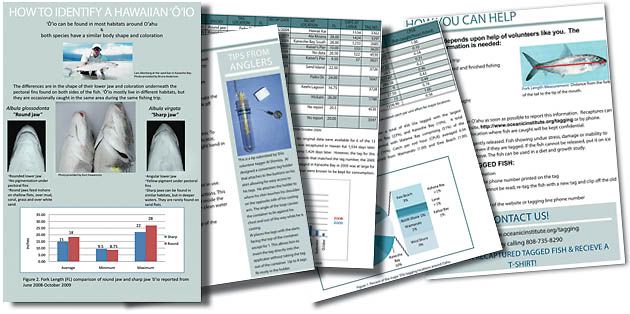
By Kimberlee Harding
"The results from these trials showed that air exposure is the most influencing factor of whether a fish will lose its equilibrium, longer exposure to air caused blood lactate levels to increase regardless of the exercise time."--more
________________________
Global Warning--Beaverdam
Reservoir
“This is an extraordinary year for Virginia,”
said Governor Kaine. “We have never sought a
statewide drought disaster designation before.
This year’s drought is so pervasive, however,
that we decided to act on behalf of the entire
state.” --more
________________________
The Hawaii Bonefish Tagging
Project
From 'Current
Line', a Hawaii Dept. of Land and Natural
Resources newsletter and reproduced with
permission from the author
By
Bruce S. Anderson, PhD
The sound of the thick fly line cutting through
the water as the fish rips out a hundred yards of
backing is sweet music to the ears of every
saltwater fly fisherman. You either love the
flats–and you check the tides and your calendar
everyday to see if you can sneak away for a few
hours–or you can’t understand why anyone in their
right mind would waste so much of their time
doing something with so few tangible rewards. If
you’ve read this far, you’re probably in the
former group.
There are probably less than two dozen hard-core
fly fishermen in Hawaii. Veteran saltwater fly
fishermen who call Hawaii home, Dick Gushman, Jim
Romig, Kelvin Taketa, Ron Lum and others travel
all over the world “chasing” bones. Enthusiastic
newcomers to the sport, like me, only dream about
the Seychelles, New Caledonia, Palmyra Island and
some of the other exotic destinations they have
fished in their travels. One thing we all share
in common is that we would rather be walking the
flats anywhere than doing anything–well, almost
anything else.
Some refer to them as “grey ghosts” of the flats.
O’io, as they are known to most
fishermen in Hawaii, are indeed grey or sometimes
light green in appearance. They have shiny,
silver scales that reflect the color of the
bottom and the fish’s surroundings. of a bonefish
Without bright sunlight to cast a shadow, they
are difficult to spot even if you are looking
directly at them with polarized glasses.
Next to ulua, papio (jack
crevalle) and other jacks, bonefish are the most
sought after inshore game fish for recreational
fishermen in Hawaii. Despite their popularity,
little is known about their distribution,
movement, or growth rates. Surprisingly, little
is known about bonefish behavior worldwide. The
fact that bonefish are not a commercially
important food fish is one of the reasons. From
this standpoint, the species is grossly
undervalued as a resource.
What we know and
don’t know
Only the basic life cycle of bonefish has been
described in the many books and articles on the
subject. They travel in loose schools, route out
shrimp, shellfish, crabs, and fish from the
bottom for food, and spawn offshore. Eggs hatch
into a ribbon-like larvae that metamorphose into
fish-like form at about two inches; then, the
fish move inshore. Mature fish are commonly found
feeding on inshore, shallow flats, usually over
mud, coral and grass and, occasionally, over
white sand. Otherwise, little is known about
bonefish movements or reproductive behavior. Most
fishermen do not know that there are two species
of bonefish in Hawaiian waters,
glossodonta, also called “Roundjaw”
bonefish, and Albula neoguinaica, called
“Sharpjaw” bonefish. While the two have been
unequivocally established as discrete species
using biochemical markers and examining their
internal skeletal structures, it is challenging
to distinguish them by appearance. The only
visible anatomical feature that differentiates
the species is the shape of their lower jaw. The
Roundjaw species generally has a broadly-rounded
lower jaw. The Sharpjaw species have an angular
lower jaw which is more or less pointed.
These two species of bonefish evolved in Hawaiian
waters over a period of over 30 million years.
They were an important fish in Hawaiian culture.
However, there is little historical information
that would allow a comparison of fish populations
over time and there is no historical data on
recreational fishing catches in Hawaii. Only
anecdotal reports from fishermen suggest the
numbers of bonefish have decreased dramatically
over the past two decades, presumably because of
over fishing and habitat loss. We do know the
number of pounds of commercial bonefish landed
has decreased dramatically, from 70,000-100,000
pounds per year in the late 1940’s to less than
10,000 pounds per year since 1985.
What we need to
know
We have some information, but we need to know a
lot more about bonefish in Hawaii if we are going
to develop appropriate resource management and
protection programs. We need to know about their
distribution and movement to know where
conservation programs would be most effective. We
also need to know their growth rates to determine
stock maturity and reproduction rates. This is
basic information needed for any conservation
program intended to preserve and protect bonefish
or any other species. It is also critical that we
collect this information in Hawaii. Hawaii is
very different from the Gulf of Mexico and the
Caribbean where other studies are underway. The
geographic isolation of the individual Hawaiian
Islands and long distances and deep channels
between the islands provides a very different
habitat than other areas where bonefish are
found. In the Caribbean, for example, bonefish
have been known to travel for over fifty miles.
However, this is in an area where fish could swim
hundreds of miles along coastlines with similar
habitat without encountering substantial
barriers. The deep ocean channels between the
Hawaiian Islands pose a formidable barrier and
dramatically curtail bonefish movement. We will
likely discover that we have much more in common
with other Pacific Islands, such as Palmyra
Atoll, where the Nature Conservancy has also
begun a bonefish tagging project. The information
we collect from this project should have
relevancy elsewhere in the Pacific.
Filling the
gaps
Several months ago, a group of fishermen and
fisheries management experts, including Dr.
Gordon Grau and Dr. Richard Brock got together to
talk about ways to fill in the gaps of what we
don’t know about bonefish in Hawaii. With
financial support from the University of Hawaii
Sea Grant College Program, the O’io Tagging
Project was born. It’s purpose is to collect
information to characterize the bonefish resource
to support appropriate resource management and
conservation programs.
Finally, dependent on the amount of information
fishermen provide, it is hoped that this study
will begin to define the “catch-andrelease
effort” for the fishery around Oahu. At present,
there is no data available to describe fishery
dynamics, the hours spent fishing, the size of
the catch, or the effects of exploitation because
the catches of recreational fishermen are not
reported.
Tagging
The bonefish caught by those participating in the
project will be tagged utilizing anchor tags and
methods previously developed for the “Ulua
Tagging Project” and adapted to bonefish. Annette
Tagawa and Clay Tam, Education Specialists with
the Division of Aquatic
Resources of the Department of Land and
Natural Resources, have been invaluable in
providing technical guidance in this regard.
Essentially, the tagging method involves
inserting a thin, polyethylene dart tag, commonly
called a “spaghetti” tag, in the area high on the
back of the fish. A plastic barb on the head of
the dart tag keeps the tag from pulling out of
the fish after it is pushed through the muscle
and between the bones just below the dorsal fin.
The tag has an identifying number and telephone
number to call to report information when the
fish is captured. After the fish is tagged, the
tag number, the species, the fork length
(measured from the tip of the mouth to the fork
of the tail), the date and time of capture and
the location is recorded and reported. Upon
recapture, the same information is recorded and
reported.
A dedicated telephone line has been setup at
Nervous Waters Fly Fishers
in Kaimuki to receive calls and record this
important information. To date, 12 fishermen,
including professional fly fishermen Clay Yee
and Kevin Faucheux at Nervous Water Fly
Fishers, have volunteered to participate in
this project. Because of limited supplies and
equipment that could be purchased with the
grant funds, a maximum of 20 participants
fishermen will be recruited the first year.
Our target is to tag 1000 fish over this
period. It is hoped that funds will be
available to continue the project and expand
the number of participants over the next few
years. All fishermen, of course, are
encouraged to report the capture of tagged
fish. Data on the exact location fish are
caught will be kept confidential; only summary
statistics will be reported for areas such as
Kaiaka Bay, Mamala Bay, Kaneohe Bay, etc. This
will allow detailed tracking of movement
without giving away your favorite fishing
spots!
What we expect to learn It is anticipated that
within a year or so, we will have some limited
information on bonefish movement (in miles),
dispersion, and, possibly, mixing patterns by
species.
Preliminary information on growth from tagging
and recapture data may also be available,
depending on recapture rates. As more fish are
tagged, we can, of course, expect more to be
recaptured. We plan to develop accurate and
verified length and weight curves to encourage
the release of fish that are caught. Using data
on the date and time of capture, it may also be
possible to retroactively determine environmental
factors, such as tides, phases of the moon, and
perhaps other factors that may influence bonefish
movements and behavior.
All fishermen who participate in this program
whether tagging or in recovery of tagged bonefish
will be given information pertaining to that
particular fish. When the fish is first caught,
this will include confirmation of the date
caught, the location captured, and the fork
length of the fish. Upon recapture, information
provided will include the date, location, and
fork length of the fish and a history of its
previous captures, including the days free,
distance traveled (in miles) and growth (in
inches) between captures.
(Note:
Due to lack of funding the tagging project
was terminated in 2006 but was revived by
the Oceanic Institute
in 2007 and is currently compiling
statistics submitted by anglers throughout the
state.)
The Competitive
Tablescaper
By Morgan Buckert
My first guide trip was absolutely freaking terrifying. I’d worked a year and a half in a fly shop for this day, and I felt like I could pass out at any moment because I was so nervous--more
Seoul fishing
By James Card
New York Times
If “Blade Runner” were turned into a fishing program, this would be the filming location.--more
Casting for trout
By Mindy Fetterman
USA Today
Yet as I stood in the middle of Montana’s Madison River with a pair of eagles flying overhead and the Madison Mountains beside me, I felt nearly hypnotized as I cast, cast, cast for rainbow trout.--more
Blooping crazy
By Dave Barry
People were always pointing at the water and saying, "Look! Trout!" But I saw nothing. I wondered if these people were like that creepy little boy in the movie "The Sixth Sense" who had the supernatural ability to see trout.--more
The Urban Frontier
By Justin Scheck
The Wall Street Journal
Mr. Teasdale's fly-fishing hole is on the South Platte River, at the mouth of a 6-foot-wide corrugated-metal drainpipe and downstream from a wastewater-treatment plant. When Mr. Teasdale walks alone past the graffiti-covered overpass and down the littered trail in this Denver suburb, he brings his Glock 9mm pistol to ward off "shady characters."--more
Fly fishing
with Darth Vader
By Mark Lasswell
The Wall Street Journal
"Telling trout purists you're chasing lowly catfish with a fly rod is tantamount to telling Heidi Klum that what you're really attracted to is bearded women with no teeth,"--more
The Zen of Fly Fishing
By Jerome Cramer
Time Magazine
To the uninitiated, the sport may seem ridiculously simple: take a long pole ; with a line, attach a fake bug and toss it at some unsuspecting fish.--more
A perfect excursion
By John Briley
Special to The Washington Post
...hope is renewed that this time, dammit all, that lunker will strike--more
The 'Tamazon' River
"The Tama river just outside of Tokyo has earned the name "The Tamazon". The murky waters contain so many tropical fish they now outnumber local species 5-1."--more
_____________________

An online digital
copy of a classic book--more
_____________________
